

At the beginning of the eighteenth century, flowered patterns, trees, pagodas, and sometimes Chinese figures in landscape and hand-painted Chinese wallpaper, referred to as chinoiserie, became the rage, which was considered by the elite to be the most stunning and intricate wallpaper. Chinoiserie wallpapers were usually painted by hand. The result was charming-a rich and exotic decoration that took Europe by storm. This fanciful wallpaper reached the height of its vogue between 1740 and 1790. Imported in large quantities, chinoiserie lined nearly every great house in Europe. This type of chinoiserie paper remained popular. and found its way into manor houses, places, and chateaux. It was often applied in panels and could be edged with gilt. The earliest designs feature birds and flowers with foliage, painted on a background of plain silk, often pale blue, grey, cream or light green. The design is light and free and the drawing in outline filled with clear bright colours. Branches of bamboo and flowering shrubs intermingle, while peonies and roses flowers amidst waving grass. Birds, butterflies and other insects perch among the leaves.
This tradition continues today. Nowadays, our artists are still hand painting this kind of very rare wallpapers. We hold the faith that:
There is no boundary for real art, but it must be rooted in tradition. Endless vigour hence comes forth.
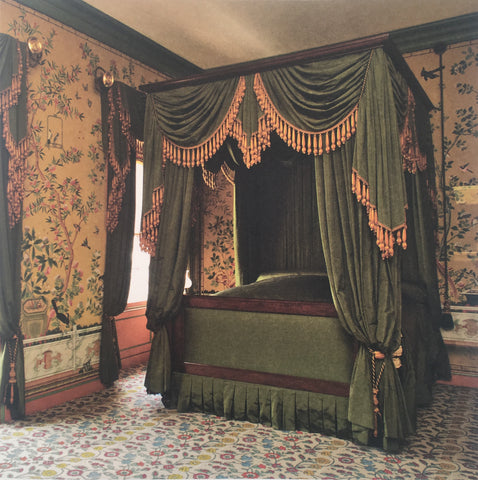
Handpainted Chinese wallpaper on a yellow ground, c 1800. Bedroom of Queen Victoria, Royal Pavilion, Brighton
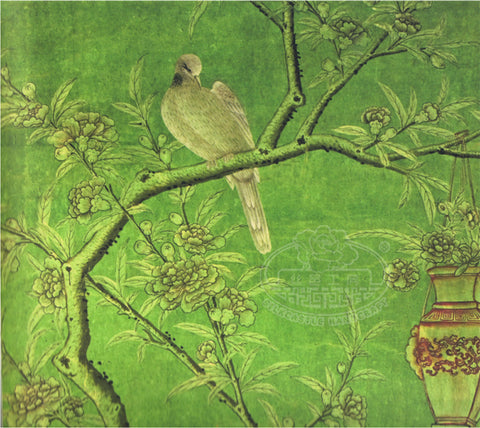
Handpainted Chinese wallpaper with large birds in fruit and flower-laden trees on an ecru ground, originally from the Chambre aux Oiseaux Latour, Normandy, 18th century. Private collection
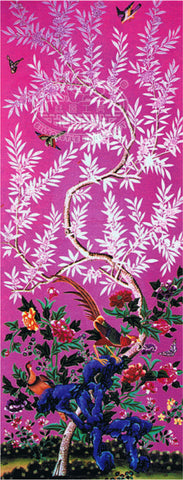
This Chinese handpainted panel with a flora-and-bird design was exported by the Canton school in the 1800s. Carolle Thibaut Pomerantz Collection
